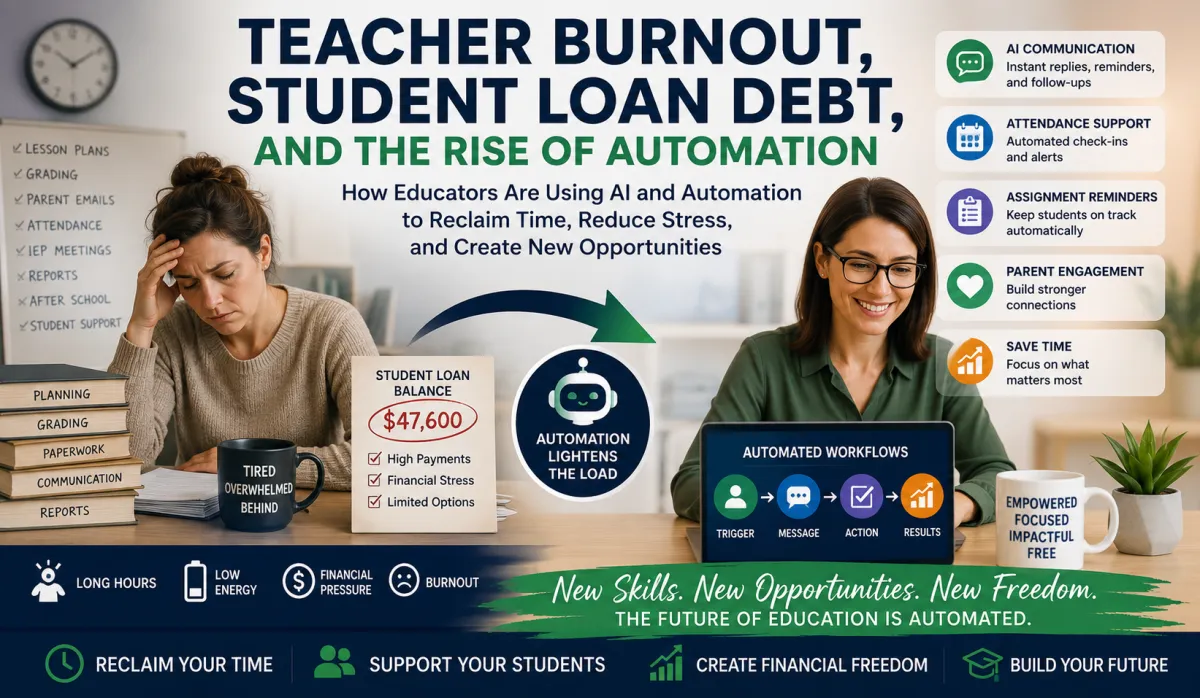
Teacher Burnout, Student Loan Debt, and the Rise of Automation
Teacher Burnout, Student Loan Debt, and the Rise of Automation
Introduction
Teachers entered education to make a difference.
But for many educators today, the reality of the profession looks very different from what they imagined.
Teachers are now balancing:
growing workloads
chronic absenteeism
increasing communication demands
emotional stress
unpaid after-school responsibilities
student loan debt
rising living costs
pressure to improve outcomes with limited support
At the same time, many educators are realizing they need additional income just to stay financially stable.
Recent research from Gallup and the Walton Family Foundation found that 71% of U.S. teachers report holding at least one second job or side hustle. (Walton Family Foundation)
Many of these second jobs happen during the school year itself — not just during summer break. (Walton Family Foundation)
For some educators, the financial pressure is connected directly to student loan debt required to obtain their teaching credentials and degrees.
This growing pressure is contributing to burnout across education.
Teacher Burnout Is More Than Exhaustion
Burnout is not simply “being tired.”
Teacher burnout often includes:
emotional exhaustion
feeling overwhelmed
lack of time
stress from constant demands
frustration with administrative pressure
compassion fatigue
reduced work-life balance
financial stress
Many educators spend hours after school:
contacting parents
following up with absent students
answering emails
grading assignments
documenting interventions
preparing lessons
supporting struggling students
Much of this work happens outside contracted hours.
Teachers care deeply about students, but many feel they are carrying an impossible workload.
The Financial Reality Facing Educators
Many educators pursued advanced degrees because teaching required it.
However, the cost of:
credentials
master’s degrees
certifications
continuing education
doctoral programs
often resulted in long-term student loan debt.
At the same time:
inflation increased
housing costs increased
healthcare costs increased
retirement uncertainty increased
Recent national reports show many teachers now rely on:
tutoring
coaching
ride-share driving
retail jobs
online businesses
freelance work
educational side hustles
simply to maintain financial stability. (Walton Family Foundation)
This financial strain often compounds burnout.
Why More Teachers Are Looking for Side Income
Many educators are no longer looking for:
“another exhausting second job.”
Instead, they are searching for:
flexible income
online income
future-ready skills
automation systems
scalable opportunities
business ownership
ways to leverage their experience
Teachers already possess valuable skills:
communication
leadership
organization
coaching
curriculum development
relationship building
problem-solving
The challenge is learning how to apply those skills in modern digital systems.
The New Opportunity: AI and Automation
One of the biggest shifts happening today is the rise of:
AI automation
Conversation AI
workflow systems
communication automation
CRM systems
AI voice assistants
Many educators are realizing these systems can help:
save time
reduce repetitive tasks
improve communication
improve student engagement
reduce burnout
Some educators describe Conversation AI as:
“having an AI assistant.”
What Conversation AI Can Do for Educators
Conversation AI systems can help automate:
attendance follow-up
absent student communication
test reminders
missing assignment notifications
tutoring reminders
parent communication
encouragement messages
scheduling
FAQ responses
Imagine a system that can:
answer routine questions
send personalized reminders
follow up automatically
notify parents
support student accountability
communicate consistently
This allows educators to focus more on:
teaching
relationships
instruction
intervention
mentorship
instead of repetitive administrative communication.
Why Many Teachers Wish They Had This Earlier
Many veteran educators now say:
“I wish this existed earlier in my career.”
For years, teachers manually handled:
phone calls
attendance outreach
parent follow-ups
appointment reminders
intervention communication
often late into the evening.
Today, automation systems can support much of that communication while still keeping interactions personalized.
The goal is not replacing teachers.
The goal is helping teachers reclaim TIME.
Automation + Education + Income
Some educators first discover automation because they want to:
save time
reduce burnout
improve communication
But after learning these systems, many realize something else:
Schools, teachers, coaches, tutors, and organizations all need help implementing AI and automation.
As a result, some educators choose to:
help other teachers implement systems
become affiliates
offer setup services
build educational businesses
create consulting services
build online communities
teach automation skills
This creates opportunities for:
additional income
recurring income
flexible business ownership
retirement preparation
financial breathing room
Important Note:
Results vary based on effort, implementation, and experience.
The Future of Education and AI
AI is not going away.
Schools, businesses, and organizations are increasingly adopting:
automation
AI communication
CRM systems
workflow technology
AI assistants
Educators who understand these systems today may become leaders tomorrow.
Teachers already know how to:
communicate
guide people
build relationships
solve problems
Technology simply expands their reach.
Final Thoughts
The education profession is changing.
Teachers are looking for:
sustainable careers
financial stability
work-life balance
future-ready skills
systems that support students and teachers
Automation and Conversation AI are becoming part of that future.
For many educators, this is not just about technology.
It is about:
reclaiming time
reducing stress
improving communication
supporting students
building financial stability
creating options for the future
Next Steps
Free Webinar:
https://mentor.teachleadandinspire.com/allie-webinar
30-Day Bootcamp:
https://mentor.teachleadandinspire.com/bootcamp-30-day
Schedule a Strategy Session with Dr. Smith:
https://annapoliscreed.com/bookingpage
Tax Disclaimer:
Software and business expenses may qualify as deductions depending on your individual situation. Please consult your tax professional.
References (APA 7th Edition)
Gallup. (2026).Walton Family Foundation-Gallup K-12 teacher research.https://www.gallup.com/analytics/659819/k-12-teacher-research.aspx
Gallup, Walton Family Foundation, & Bipartisan Policy Center. (2026).Teaching for Tomorrow: Financial realities and teacher sustainability. Walton Family Foundation.https://static.waltonfamilyfoundation.org/0e/68/91eb12ad4017a6ee5d4aa4f4afd0/gallup-wff-bpc-stayingpower-021926.pdf
Walton Family Foundation. (2025, June 25).The AI dividend: New survey shows AI is helping teachers reclaim valuable time.https://www.waltonfamilyfoundation.org/the-ai-dividend-new-survey-shows-ai-is-helping-teachers-reclaim-valuable-time
Walton Family Foundation. (2026, March 2).New report shows many teachers rely on second jobs to make ends meet: Some side gigs show negative impact on teaching.https://www.waltonfamilyfoundation.org/about-us/newsroom/new-report-shows-many-teachers-rely-on-second-jobs-to-make-ends-meet-some-side-gigs-show-negative-impact-on-teaching
Walton Family Foundation. (2026, March 2).What teachers’ extra jobs reveal about supporting the profession.https://www.waltonfamilyfoundation.org/learning/what-teachers-extra-jobs-reveal-about-supporting-the-profession
WDBJ7. (2026, March 3).71% of teachers work at least one side gig, survey reveals.https://www.wdbj7.com/2026/03/03/71-teachers-work-least-one-side-gig-survey-reveals/
ABC15 Arizona. (2026, March 3).Survey: 71% of US public school teachers have a second job.https://www.abc15.com/news/education/survey-71-of-us-public-school-teachers-have-a-second-job
KSAT. (2026, April 29).Many teachers juggle side jobs to make ends meet, study finds.https://www.ksat.com/news/local/2026/04/29/many-teachers-juggle-side-jobs-to-make-ends-meet-study-finds/