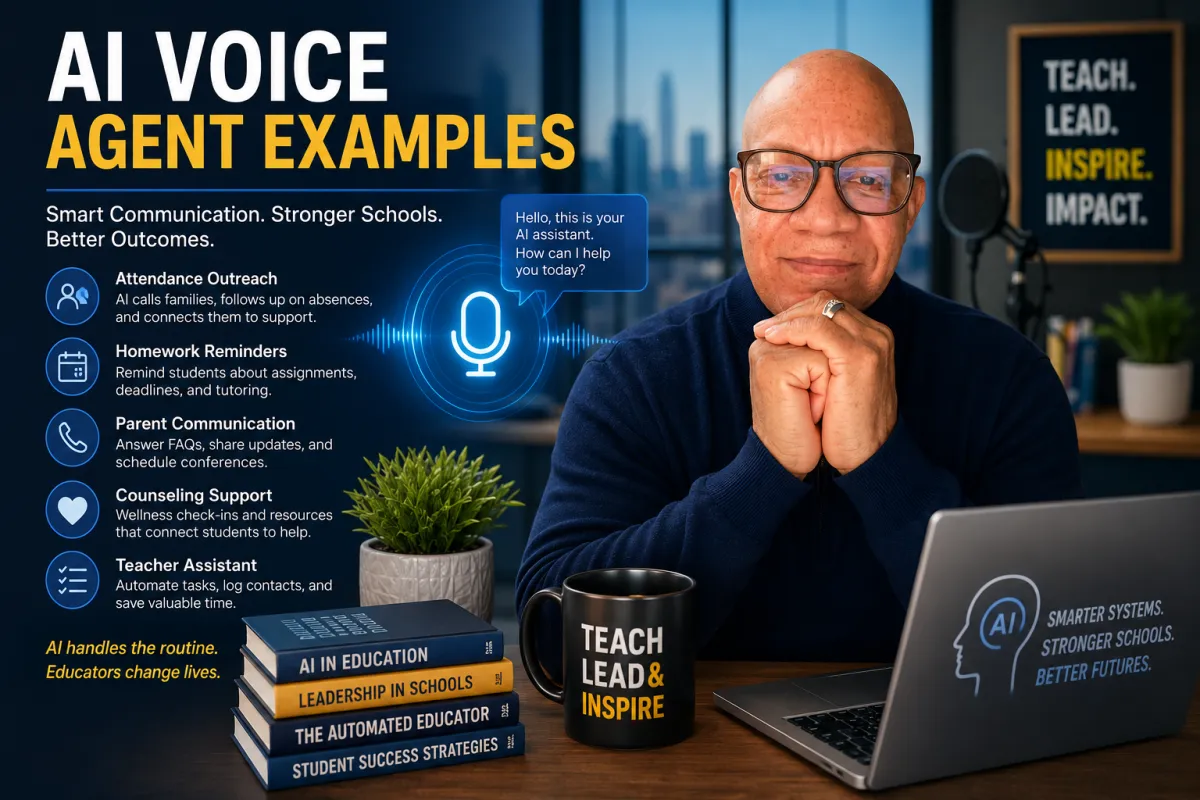
AI Voice Agent Examples for Schools and Educators
AI Voice Agent Examples: How Educators and Schools Can Use AI to Improve Communication and Student Outcomes
By Dr. Jordan B. Smith Jr.
Introduction
Artificial intelligence is rapidly transforming how schools communicate, support students, and manage daily operations. One of the most exciting developments is the rise of AI voice agents—automated systems capable of speaking naturally with students, parents, staff, and community members.
Unlike traditional robocalls, modern AI voice agents can answer questions, personalize responses, schedule appointments, provide reminders, and even guide conversations based on specific goals.
For educators, this technology has the potential to reduce workload, improve communication consistency, and help address chronic absenteeism, parent engagement, and student support challenges.
The goal of AI voice agents is not to replace teachers.
The goal is to automate repetitive communication tasks so educators can spend more time building relationships and improving instruction.
What Is an AI Voice Agent?
An AI voice agent is a conversational system powered by artificial intelligence that can:
Speak naturally with users
Understand spoken responses
Answer questions
Follow workflows and scripts
Trigger automated actions
Integrate with calendars and databases
Route conversations based on needs
Modern AI voice systems use technologies such as natural language processing (NLP), machine learning, and speech recognition to simulate human-like conversations (Russell & Norvig, 2021).
These systems are now being used in healthcare, customer service, business operations, and increasingly in education.
Example 1: Chronic Absenteeism Outreach
One of the strongest applications for schools is attendance intervention.
Many schools struggle to consistently contact families when students miss school. Teachers and administrators often spend hours after school making phone calls manually.
An AI voice agent could automatically:
Call families after an absence
Ask if the student is safe
Offer support resources
Remind parents about attendance policies
Schedule counselor follow-ups
Notify intervention teams
Example conversation:
“Hello, this is the attendance support assistant from Valley High School. We noticed that Jordan was absent today. Is everything okay?”
The system could then guide the conversation based on the parent’s response.
This allows schools to respond proactively instead of waiting until attendance problems become severe.
According to the U.S. Department of Education (2023), chronic absenteeism remains one of the largest barriers to academic achievement nationwide.
AI voice systems can help schools scale communication while improving consistency.
Example 2: Homework and Assignment Reminders
Students often fall behind simply because they forget assignments or deadlines.
An AI voice agent could:
Send evening homework reminders
Remind students about tutoring
Announce upcoming tests
Provide motivational check-ins
Share missing assignment alerts
Example:
“Hi Alex, this is your Algebra support assistant. Don’t forget your tutoring session tomorrow at 3:30 PM in Room 205.”
This type of automation helps reinforce accountability while reducing teacher workload.
Example 3: Parent Communication Support
Parent communication is critical, but many educators struggle to find enough time for consistent outreach.
AI voice agents can assist by:
Answering frequently asked questions
Providing school event reminders
Sharing progress updates
Scheduling parent conferences
Translating communication into multiple languages
Research shows that strong family-school partnerships improve attendance, academic performance, and student engagement (Henderson & Mapp, 2002).
Voice automation systems can help schools maintain stronger communication systems at scale.
Example 4: Counseling and Wellness Check-Ins
Schools are increasingly focused on mental health and emotional wellness.
AI voice agents can support counselors by:
Conducting basic wellness check-ins
Asking students reflective questions
Providing calming resources
Directing students to support services
Escalating concerns to counselors
Example:
“On a scale from 1–10, how stressed are you feeling today?”
If the student reports high stress levels, the system could automatically notify appropriate support staff.
Importantly, AI systems should supplement—not replace—human counselors and trained mental health professionals.
Example 5: Teacher Productivity Assistant
Teachers are overwhelmed with repetitive administrative tasks.
AI voice agents can help educators by:
Scheduling meetings
Sending reminders
Logging parent contacts
Tracking intervention attempts
Updating CRM systems
Providing instructional prompts
For example, a teacher could say:
“Call parents of students missing three assignments.”
The AI system could automatically begin outreach workflows.
This creates efficiency while reducing administrative burden.
Example 6: Career and College Readiness Support
High school students often need reminders and guidance regarding:
FAFSA deadlines
Scholarship applications
SAT/ACT testing
College applications
Career certifications
AI voice agents can guide students through these processes using structured workflows.
This is especially valuable for first-generation college students who may lack access to ongoing support systems.
Example 7: Adult Education and Independent Study Programs
Alternative education programs often struggle with maintaining communication with students who learn remotely or asynchronously.
AI voice systems can help by:
Conducting daily attendance check-ins
Monitoring assignment completion
Scheduling support sessions
Providing encouragement
Connecting students to teachers
This type of system can improve accountability and student connection in flexible learning environments.
Benefits of AI Voice Agents in Education
Potential benefits include:
Increased communication consistency
Faster response times
Reduced teacher workload
Improved attendance follow-up
Better documentation
Scalable parent outreach
Personalized student support
Increased operational efficiency
McKinsey & Company (2023) estimates that generative AI and automation tools may significantly improve workplace productivity across industries, including education.
Important Ethical Considerations
While AI voice systems offer exciting opportunities, schools must also address ethical concerns.
Important considerations include:
Student privacy
Data security
Transparency
Human oversight
Bias prevention
FERPA compliance
Consent policies
Schools should ensure that AI systems are used responsibly and that human educators remain central to relationship-building and decision-making.
Technology should enhance human connection—not replace it.
The Future of AI Voice Agents in Schools
The future classroom will likely combine:
Human instruction
AI support systems
Automated communication
Real-time data analysis
Personalized learning pathways
Educators who learn these systems early may gain significant advantages in leadership, innovation, and instructional efficiency.
Schools that successfully integrate AI communication systems may improve:
Student engagement
Attendance
Parent communication
Staff efficiency
Intervention response times
The schools of the future may not necessarily have more staff.
They may simply have better systems.
Final Thoughts
AI voice agents represent a major shift in how schools can communicate and support students.
Used responsibly, these systems can reduce repetitive workload, improve responsiveness, strengthen family communication, and help educators focus on what matters most—human relationships and learning.
The future of education will not be built on technology alone.
It will be built on educators who understand how to combine compassion, leadership, communication, and intelligent systems to better serve students and communities.
AI voice agents are not the future by themselves.
They are tools.
The educator remains the difference-maker.
References
Henderson, A. T., & Mapp, K. L. (2002).A new wave of evidence: The impact of school, family, and community connections on student achievement. Southwest Educational Development Laboratory.
McKinsey & Company. (2023).The economic potential of generative AI: The next productivity frontier.https://www.mckinsey.com
Russell, S., & Norvig, P. (2021).Artificial intelligence: A modern approach(4th ed.). Pearson.
U.S. Department of Education. (2023).Every student, every day: Strategies for reducing chronic absenteeism.https://www.ed.gov