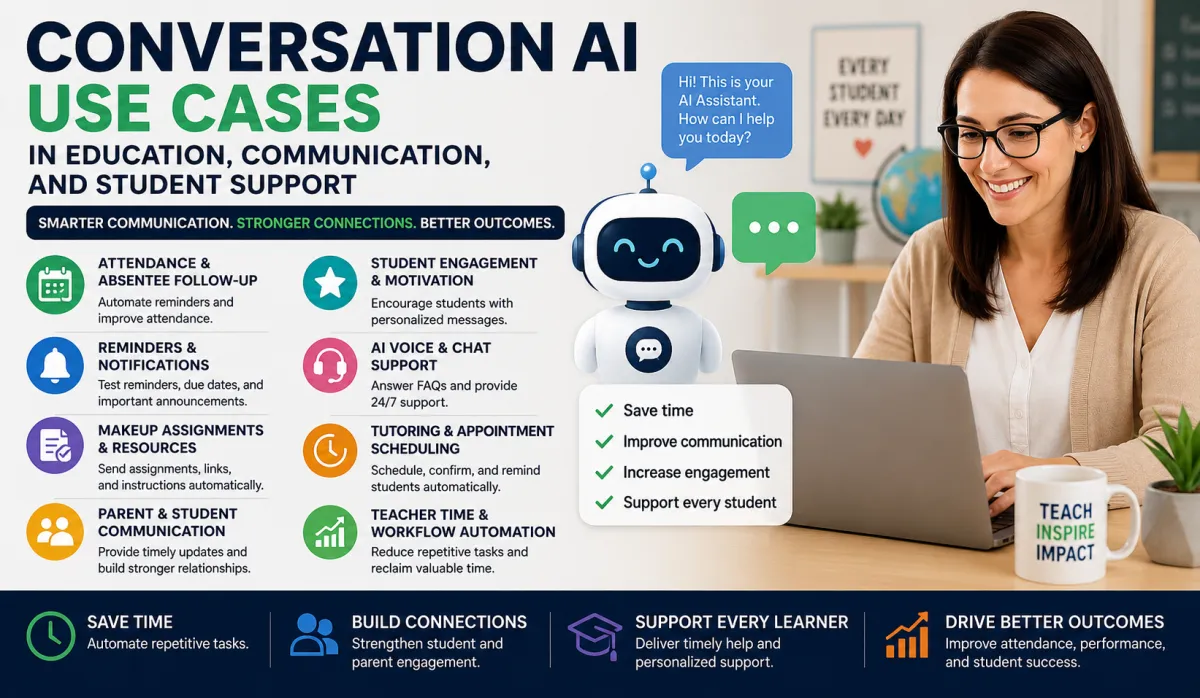
Why Educators Are Exploring Conversation AI in 2026
Conversation AI Use Cases in Education, Communication, and Student Support
Introduction
Education is entering a new era of communication.
Teachers, schools, tutors, coaches, and educational organizations are increasingly exploring how Conversation AI can help improve:
communication
engagement
attendance
organization
support systems
operational efficiency
Conversation AI refers to systems that use artificial intelligence to communicate naturally through:
text messages
chat
email
voice calls
automated assistants
AI-powered workflows
These systems can help automate repetitive communication tasks while still maintaining personalized interactions.
The goal is not replacing teachers.
The goal is helping educators reclaim TIME while improving communication consistency and student support.
Recent research and educational technology reports suggest that AI-powered assistants and conversational systems may help reduce administrative workload, improve accessibility, and support more personalized educational experiences. (EdTech Magazine)
1. Attendance and Chronic Absenteeism Support
The Challenge
Many schools struggle with chronic absenteeism.
Teachers and staff often spend hours:
making phone calls
sending emails
documenting interventions
following up with families
Much of this work happens after school hours.
Conversation AI Use Case
Conversation AI can help automate:
attendance reminders
absence follow-ups
wellness check-ins
parent communication
escalation workflows
Example
Student absent:
“Hi Jordan, we missed you in math class today. Please check Canvas for today’s assignment and let your teacher know if support is needed.”
Parent message:
“We noticed Jordan was absent today. Please contact the school if assistance is needed.”
Benefits
improves communication consistency
saves staff time
supports MTSS systems
improves accountability
helps identify at-risk students earlier
Educational AI support systems are increasingly being used to automate repetitive support tasks and provide faster student communication. (The School House)
2. Test, Quiz, and Assignment Reminders
The Challenge
Students often forget:
tests
due dates
tutoring appointments
project deadlines
Teachers repeatedly answer the same questions.
Conversation AI Use Case
Conversation AI can automatically:
send reminders
provide study tips
link review materials
answer FAQ questions
notify students about upcoming assessments
Example
“Reminder: Algebra quiz tomorrow at 9 AM. Review solving systems of equations tonight and get a good night of sleep.”
Benefits
improves preparedness
reduces anxiety
supports executive functioning
reinforces accountability
3. Makeup Assignment Automation
The Challenge
Students who miss school often become overwhelmed trying to catch up.
Teachers manually organize and communicate missing work repeatedly.
Conversation AI Use Case
Automation systems can:
send missing assignments automatically
include due dates
provide tutorial links
encourage re-engagement
answer basic assignment questions
Example
“Hi Sarah — here are the assignments you missed while absent. Focus on completing one task at a time. You can do this.”
Benefits
improves assignment completion
reduces repetitive communication
supports struggling students
improves organization
4. Positive Parent Communication
The Challenge
Parents often hear from schools only when problems occur.
Conversation AI Use Case
Conversation AI can automate positive communication when students:
improve grades
participate
attend consistently
complete assignments
demonstrate growth
Example
“Mrs. Johnson — Jordan participated exceptionally well in class today and completed all assignments. Great progress.”
Benefits
builds stronger relationships
improves school culture
increases student motivation
improves parent trust
5. AI Voice Assistants for Student Support
The Challenge
Teachers and schools receive repetitive questions daily.
Conversation AI Use Case
AI voice systems can answer:
office hour questions
assignment deadlines
tutoring schedules
attendance procedures
FAQ questions
Recent educational technology reports describe growing adoption of AI-powered teaching assistants and chatbot systems that support student access and communication. (EdTech Magazine)
Benefits
24/7 support availability
reduced repetitive calls
faster response times
improved accessibility
6. Student Motivation and Encouragement
The Challenge
Students experiencing academic struggle often disengage emotionally before disengaging academically.
Conversation AI Use Case
AI systems can automate:
encouragement messages
motivational reminders
accountability check-ins
growth mindset prompts
attendance encouragement
Example
“Progress happens one step at a time. Keep showing up and doing your best.”
Benefits
supports SEL goals
increases engagement
improves consistency
reinforces positive habits
7. Tutoring and Intervention Scheduling
The Challenge
Coordinating intervention services requires significant communication and scheduling.
Conversation AI Use Case
Automation systems can:
schedule tutoring
confirm appointments
send reminders
reschedule automatically
follow up after sessions
Benefits
reduces administrative burden
improves participation
decreases missed appointments
8. AI-Powered Academic Support
The Challenge
Students need support outside regular classroom hours.
Conversation AI Use Case
AI-powered educational assistants can:
answer course-related questions
guide students toward resources
provide explanations
support self-paced learning
Research on AI-powered teaching assistants suggests these systems may help students access support more efficiently while allowing educators to focus on higher-value instructional interactions. (EdTech Magazine)
9. Teacher Burnout Reduction
The Challenge
Teacher burnout continues to rise due to:
communication overload
increasing documentation
repetitive administrative work
lack of time
Conversation AI Use Case
Automation systems can help reduce repetitive communication tasks including:
reminders
attendance follow-up
FAQs
scheduling
routine notifications
Many educators report that AI tools help reduce administrative burden and reclaim valuable time. (Microsoft)
Benefits
saves time
improves work-life balance
reduces stress
increases operational efficiency
10. Future-Ready Skills for Educators
The Opportunity
AI and automation are becoming increasingly important across:
education
business
healthcare
communication
customer support
operations
Educators who understand:
AI systems
automation
workflows
communication technology
may develop valuable future-ready skills.
Some educators choose to:
implement systems for schools
help other educators
build consulting services
become affiliates
create educational businesses
Important Note:
Results vary based on effort, implementation, and experience.
Ethical Considerations
Conversation AI should support teachers — not replace human relationships.
Organizations like UNESCO emphasize the importance of human-centered AI implementation in education. (UNESCO)
Responsible implementation includes:
maintaining teacher oversight
protecting student privacy
avoiding over-automation
ensuring transparency
using AI ethically and responsibly
Human relationships remain essential in education.
Final Thoughts
Conversation AI is rapidly changing how organizations communicate.
In education, these systems may help:
improve communication
support students
reduce repetitive tasks
improve operational efficiency
reduce burnout
enhance engagement
For many educators, Conversation AI represents an opportunity to:
reclaim time
improve student support
develop future-ready skills
explore new opportunities in education and technology
The future of education will likely include collaboration between:
educators
students
AI systems
communication automation
personalized support technologies
The educators who learn these systems today may become leaders in the next generation of education and communication.
Next Steps
Free Webinar:
https://mentor.teachleadandinspire.com/allie-webinar
30-Day Bootcamp:
https://mentor.teachleadandinspire.com/bootcamp-30-day
Schedule a Strategy Session with Dr. Smith:
https://annapoliscreed.com/bookingpage
Tax Disclaimer:
Software and business expenses may qualify as deductions depending on your individual situation. Please consult your tax professional.
References (APA 7th Edition)
Brereton, E. (2025, March 24).AI-powered teaching assistants can drive student success. EdTech Magazine.https://edtechmagazine.com/higher/article/2025/03/ai-powered-teaching-assistants-perfcon
Dong, Y. (2026).Enhancing human-AI communication in language education. Computers and Speech Communication.https://www.sciencedirect.com/science/article/pii/S0898589826000513
Liu, A., Esbenshade, L., Sun, M., Sarkar, S., He, J., Tian, V., & Zhang, Z. (2025).Adapting to educate: Conversational AI's role in mathematics education across different educational contexts. arXiv.https://arxiv.org/abs/2503.02999
Microsoft. (2025).2025 AI in education: A Microsoft special report. Microsoft Education.https://cdn-dynmedia-1.microsoft.com/is/content/microsoftcorp/microsoft/bade/documents/products-and-services/en-us/education/2025-Microsoft-AI-in-Education-Report.pdf
Račkauskaitė, E. (2026, April 24).11 AI support tools for education that cut admin time. Capacity.https://capacity.com/blog/ai-tools-for-education/
Sharples, M. (2023).Towards social generative AI for education: Theory, practices and ethics. arXiv.https://arxiv.org/abs/2306.10063
UNESCO. (2026).Artificial intelligence in education. UNESCO.https://www.unesco.org/en/digital-education/artificial-intelligence